The Emerging Role of Laser Drift Services in Upstream Oil and Gas

More than a decade ago, Stress Engineering Services introduced Laser ID inspection technology to the oil and gas industry. Since then, our teams have inspected thousands of joints of pipe and other critical tubular assets, providing clients with the data and confidence needed to make informed operational decisions. While the primary focus of these inspections has traditionally been to characterize internal wear or damage, we’ve recently seen a significant uptick in demand for Laser Drift services. These services provide a quick dimensional check (with a digital record) while also revealing wear, gouges, and subtle variations that could affect performance.
Market Shifts and Quality Challenges
Increased tariffs on foreign steel have opened new doors for domestic pipe mills. While this shift has created opportunities across the supply chain, it has also introduced new challenges. Some domestic mills are manufacturing OCTG for the first time, while others are working overtime to meet accelerated demand. This combination of inexperience and urgency can lead to quality control issues like dimensional inconsistencies and internal defects that might go undetected by traditional inspection methods.
Case Study: When Precision Matters
A client approached Stress Engineering Services with a complex challenge. They needed to set a specialized packer in a deep, high temperature well, where even small variances in internal pipe diameters could jeopardize the operation. The client had special ordered casing with strict dimensional requirements, but the mill’s data alone didn’t provide our client with enough confidence that the packer would set properly. That’s when they called upon our Laser Drift inspection services.
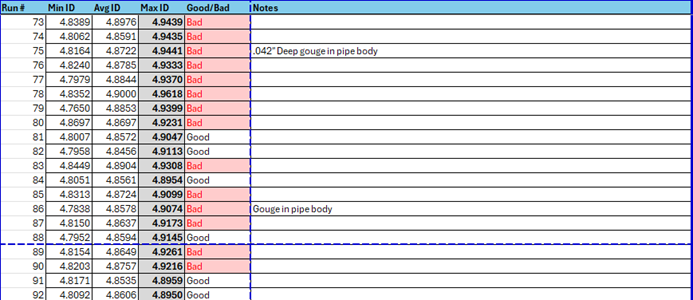
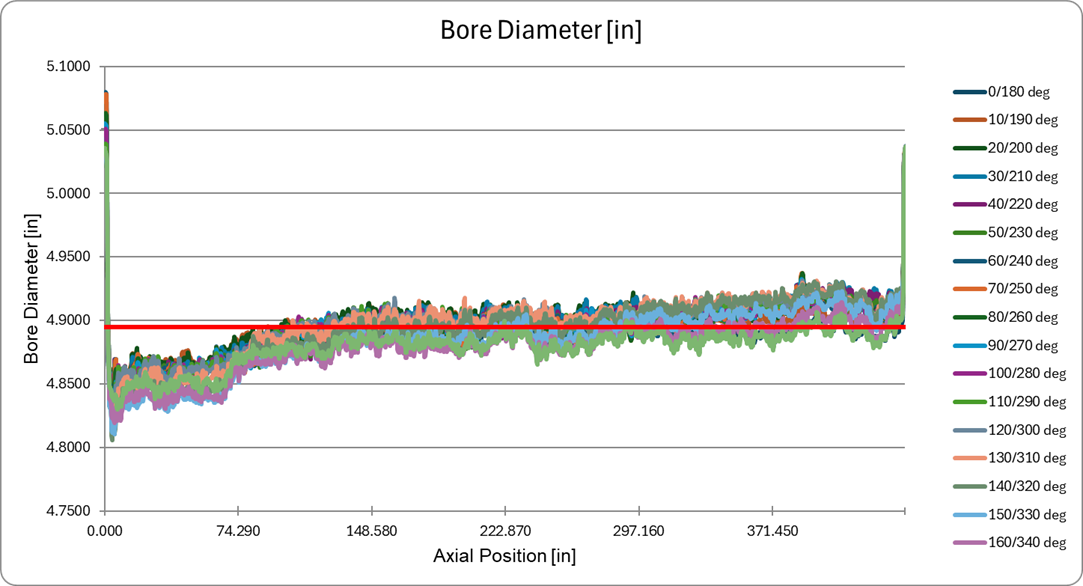
To find out if what was produced at the mill met our client’s operating standards, over 200 joints of casing were subjected to a comprehensive Laser Drift inspection. Each joint generated more than six million measurements, producing a detailed picture of its internal diameter along the entire length; all in under 7 minutes. Using real-time data analysis, we classified each pipe as “GOOD” or “BAD” based on whether it met the packer’s maximum ID criteria.
By the end of the project, the team had compiled detailed Bore Reports for every joint, capturing subtle variations, potential flaws, and anything that could affect the packer’s performance. Acceptable joints were then segregated on-site, ensuring that only these joints would be placed in the string where the packer needs to be set.
The Results
The inspection uncovered several critical insights:
- Only 40% of the joints met the Maximum ID criteria.
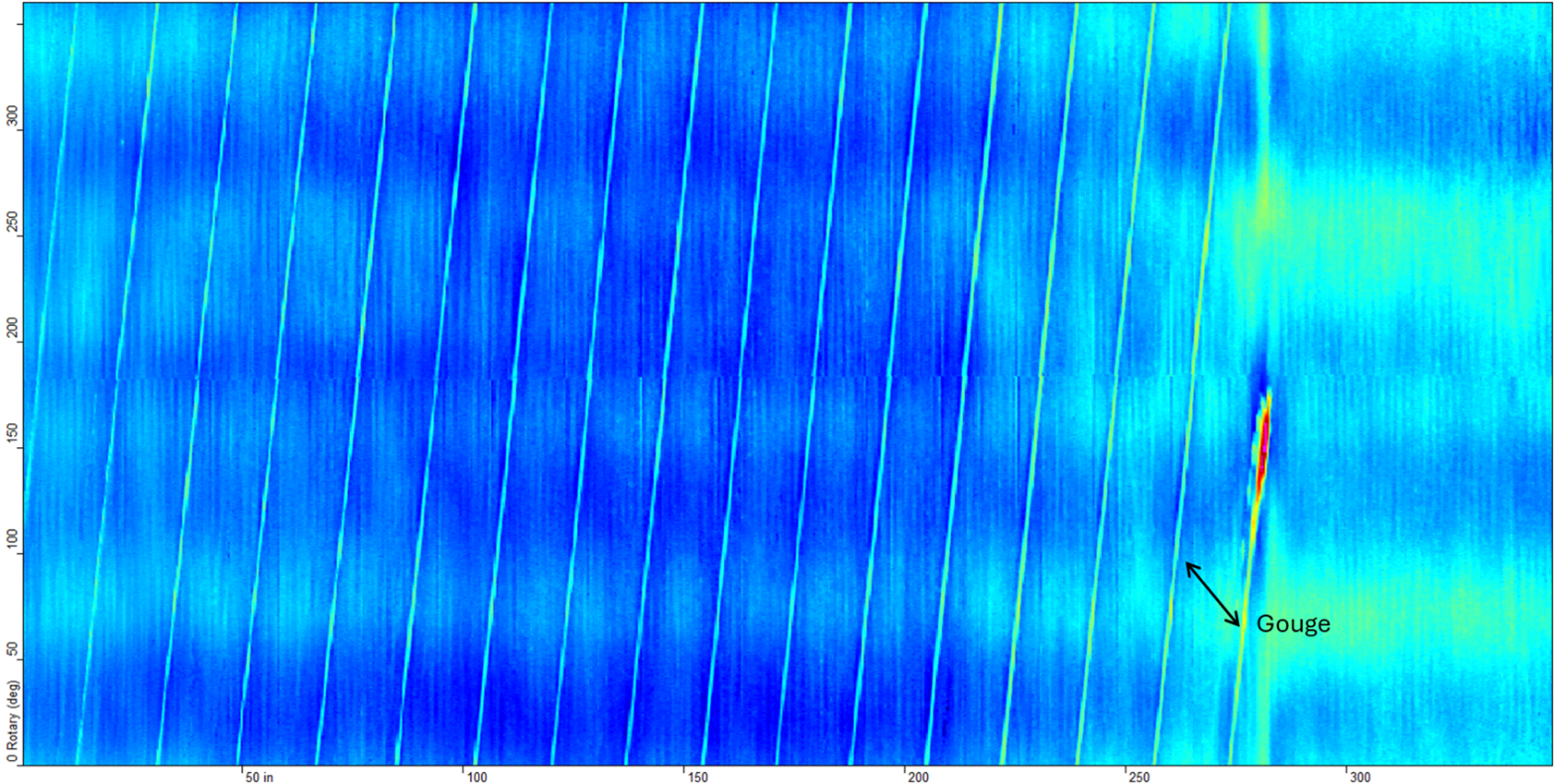
- 10% of the joints showed deep wall loss features like gouging.
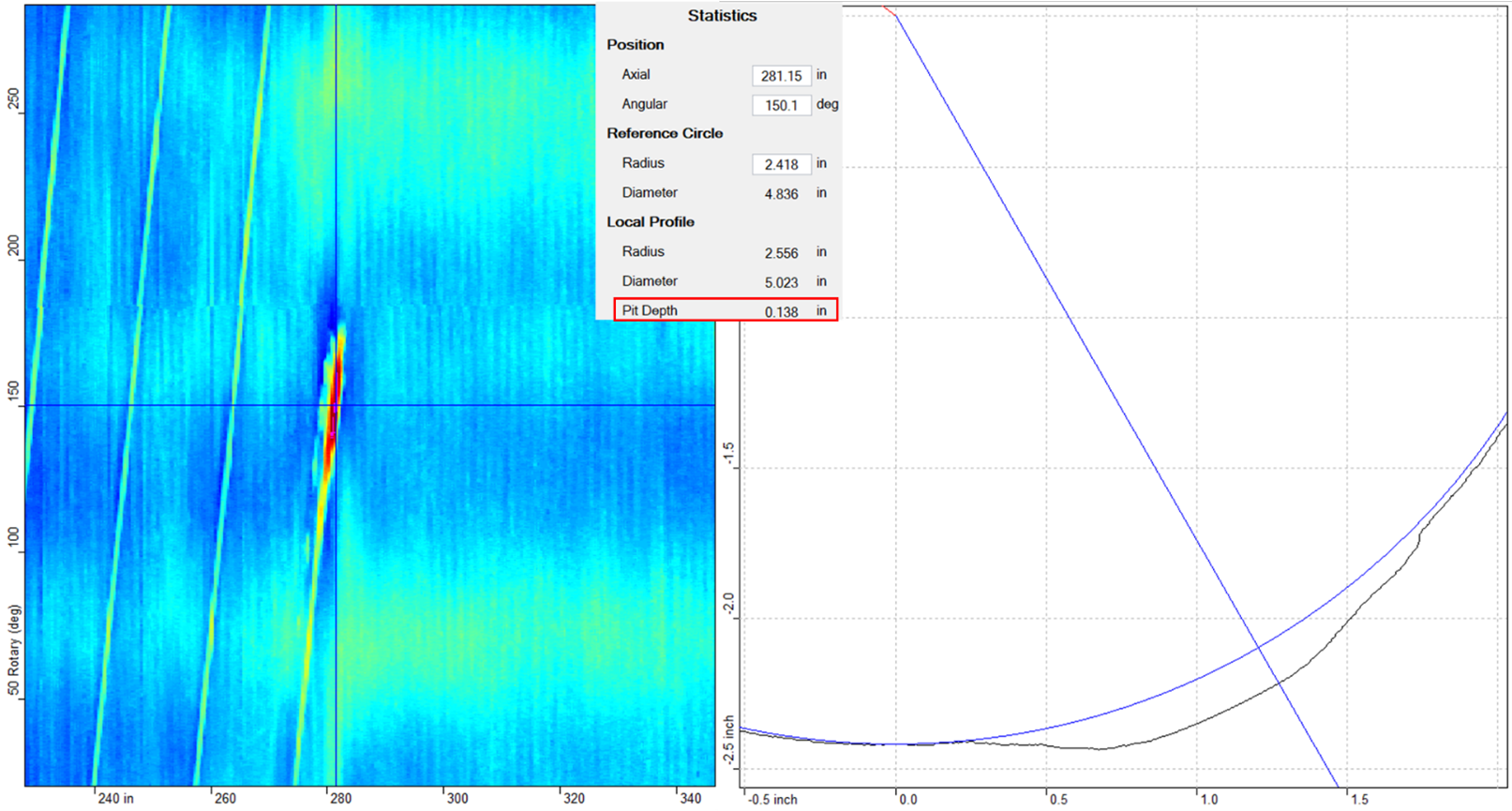
– Gouges measure approximately 5% or more of nominal wall thickness. The gouges appear to be caused by the piercing mandrel, during manufacturing. - The deepest gouge measured greater than 0.125 inches, which is over 12.5% (API 5CT) of nominal wall, and extended the entire length of the joint, forming a rifling pattern.
– Remarkably, this joint had passed the mill’s inspection process, underscoring the importance of independent verification.
These findings highlighted a critical lesson: even when equipment is manufactured to specification, variability can exist, and assumptions can be risky.
Delivering Confidence Through Data
Our Laser Drift Services deliver fast, repeatable, and highly accurate dimensional data, combined with real-time flaw detection and detailed reporting for every joint. In an environment where speed, shifting supply chains, and precision are increasingly critical, minimizing risk and ensuring performance is essential. These services extend beyond measurement to provide clarity and confidence throughout the project lifecycle. At completion, the client was equipped with verified data that clearly identified which joints met performance requirements, enabling informed decisions and a confident path forward. This is not simply inspection—it is the value of measured, validated information that supports reliability in high-stakes applications, joint by joint, inch by inch.
At Stress Engineering Services, we help clients move forward with certainty, reducing risk and improving performance across the lifecycle of every operation. By combining advanced inspection technologies with structural, mechanical, and environmental testing, Stress Engineering Services delivers the data and clarity operators need to move forward with certainty. Gathering the information required to reduce risk, optimize performance, and ensure reliable outcomes in the most demanding environments is what we do best.
Contact us to see how we can provide you with confidence in your operations through testing.

Brandon McGinn – Project Specialist at Stress Engineering Services
Brandon specializes in state-of-the-art laser profilometry tools and gathering data about the geometry of the internal surface (ID) of a pipe or other round sample. From the data collected, conclusions can be drawn about the condition of the surface of the sample and any features, anomalies, or defects can be characterized.


Leave a Comment
You must Register or Login to post a comment.