Elastomer Formulation Matters: Lessons from Seal Failures in Oil & Gas Service
To understand that elastomer seal reliability depends on the complete compound formulation, not simply the base polymer designation.
Selecting an elastomer for oil and gas service involves more than choosing a polymer family such as HNBR or FKM. Plasticizers, fillers, cure-system components, stabilizers, and processing aids influence hardness, flexibility, dimensional stability, compression-set resistance, and chemical compatibility. When these ingredients migrate or are extracted during service, sealing performance can change significantly.
Case Study 1: Plasticizer Leaching and O-Ring Damage
A service-exposed HNBR O-ring showed extrusion and nibbling. Compared with the reference material, the seal exhibited increased hardness, reduced thickness, lower organic content, and a higher glass-transition temperature. These findings were consistent with plasticizer leaching.
Extrusion and nibbling depends on mechanical factors such as clearance, seal squeeze, gland geometry, pressure history, hardware deflection, and back-up-ring support. However, plasticizer leaching can reduce a seal’s operating margin through hardness, ductility or dimensional changes, potentially influencing mechanical failure modes.
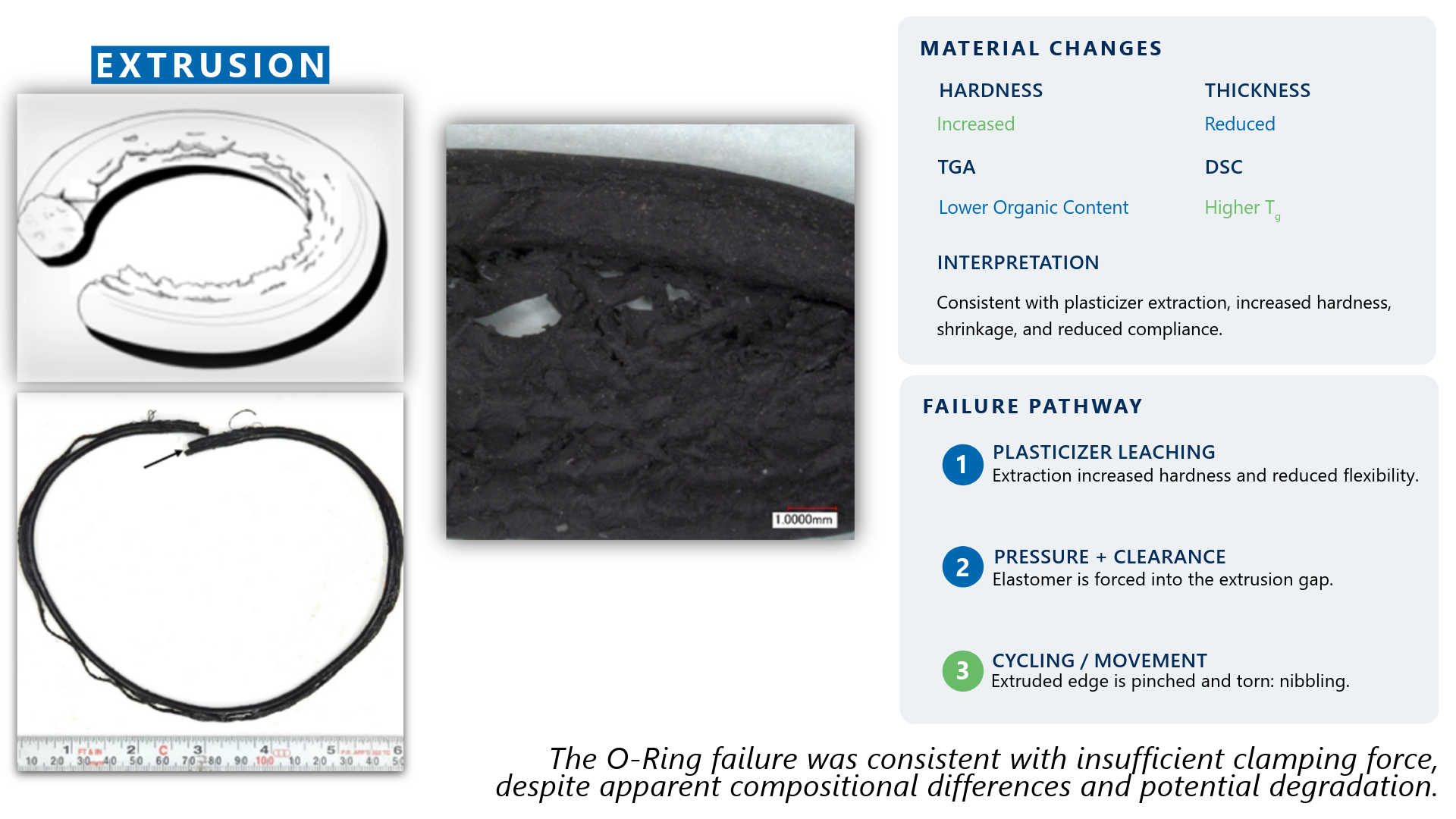
Figure 1: Plasticizer leaching increases hardness, reduced thickness, and raised the glass-transition temperature of an HNBR seal, potentially contributing to extrusion and progressive nibbling.
Case Study 2: Blooming and Compression-Set Performance
A second example involves blooming, where formulation ingredients migrated from within the fluoro-elastomer and accumulated at the surface. Unlike leaching, blooming does not require an external fluid to carry the ingredients away.
Although blooming is often treated as a surface-quality issue, migration of functional ingredients can change the effective formulation of the bulk elastomer. Blooming can cause altered compression-set behavior and reduced recovery after sustained compression.
These changes can lower contact pressure between the seal and mating surfaces, increasing leakage risk during long-term service, temperature cycling, or pressure fluctuations. The effect depends on the migrating constituent. Some wax bloom may be intentional, while migration of plasticizers, lubricants, or cure-system ingredients may adversely affect performance.
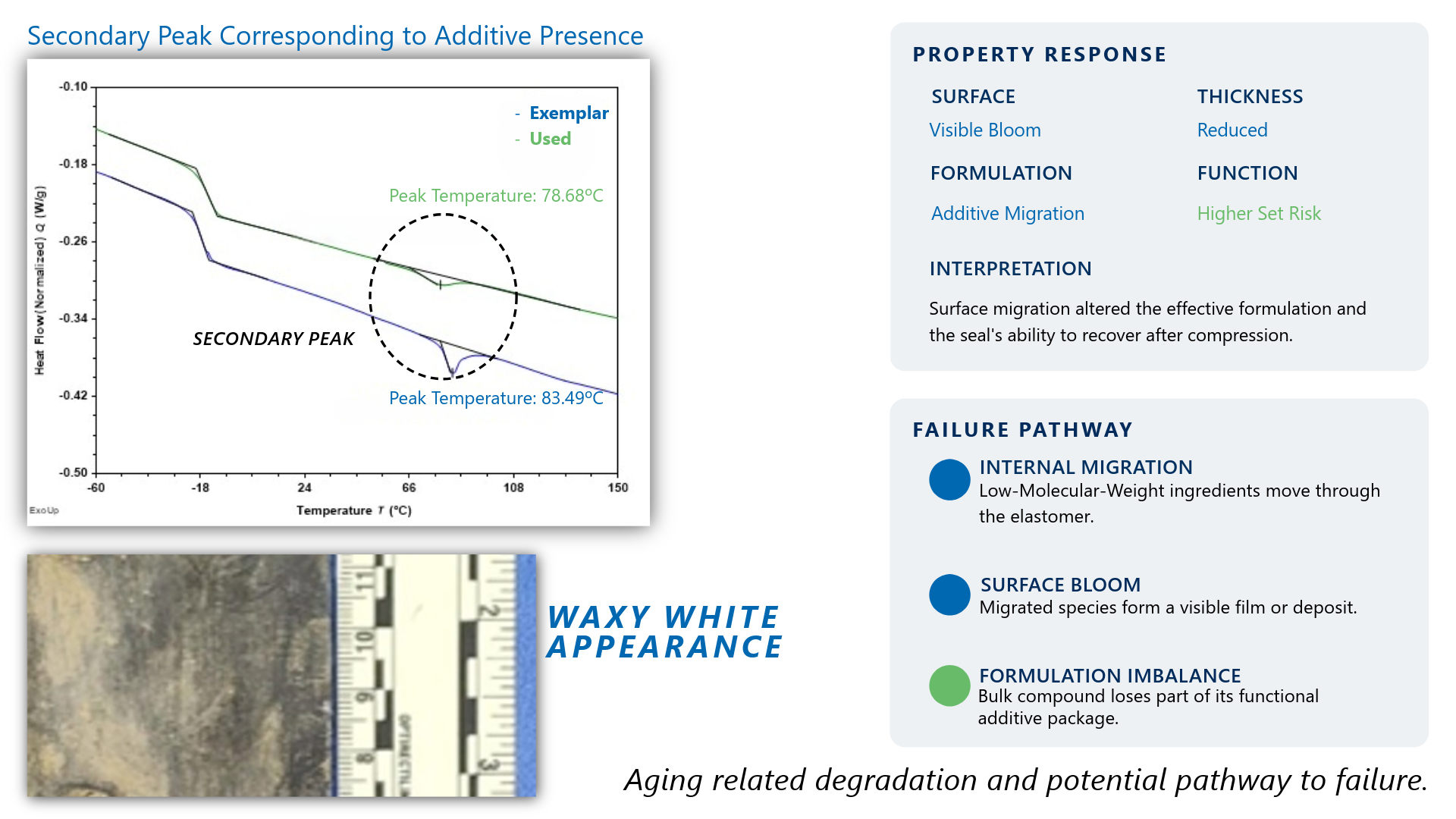
Figure 2: Migration of formulation ingredients produced surface bloom, potentially altering compression-set performance and reducing elastic recovery and retained sealing force.
Conclusion
These cases demonstrate that elastomer performance is controlled by the complete formulation and its interaction with service conditions.
Plasticizer leaching can change hardness, dimensions, and flexibility, and may affect susceptibility to mechanical damage, even for properly designed seals. Blooming can alter compression-set recovery and retained sealing force. A reliable failure assessment must therefore integrate material characterization with operating pressure, temperature, gland design, chemical exposure, and service history.
At Stress Engineering Services, Inc., we combine elastomer characterization with sealing-system evaluation and application-specific testing to identify failure mechanisms, determine root causes, and support more reliable material-selection and qualification decisions.
Seal performance is controlled by the specific chemical, thermal, pressure, and mechanical environment.

Ajay Kumar Kadiyala, Ph.D. – Senior Analyst
Ajay Kumar Kadiyala, Ph.D., is a materials scientist specializing in polymers, composites, additive manufacturing, and advanced materials characterization. He has more than a decade of experience helping organizations develop, optimize, and evaluate materials for demanding industrial applications.


Leave a Comment
You must Register or Login to post a comment.